The auditor is coming – and you don’t know where to start
Imagine: An audit is announced for the coming month. NIS2 compliance is being assessed. Your IT manager signals confidence - IT is well positioned. Then the question follows: “What about your OT systems? PLCs, HMIs, robots?”
Short silence.
This is exactly where the real challenge begins for many manufacturing companies. While IT security has been implemented in a structured manner for years, OT security – i.e. the protection of production systems – often remains incomplete.
This is currently changing fundamentally.
What NIS2 requires from manufacturing companies
Since December 6, 2025, the NIS2 implementation law (NIS2UmsuCG) has been in force in Germany. Whether your company is affected can be clarified by the BSI applicability check.
The central requirements include:
- Backup and recovery: A documented and regularly tested backup concept for all critical systems is mandatory.
- Change management: Changes to production systems must be traceably documented.
- Recovery tests: Backups must be regularly tested for their restorability.
- Integrity checks: Backups must be checked for completeness and correctness at fixed intervals.
The 5 most common deficiencies in OT audits
In practice, the same weaknesses frequently appear:
Deficiency 1: Incomplete inventory list of OT assets
Auditors start with the question: “Which systems do you operate?” An outdated Excel list is not a reliable basis.
Deficiency 2: Missing recovery tests
Existing backups alone are not sufficient. The decisive factor is proof of regular restore tests.
Deficiency 3: Changes without documentation
Adjustments to PLCs or systems are often made in everyday life without logging. In the audit, this is assessed critically.
Deficiency 4: IT backup without OT coverage
While IT systems are often secured, corresponding concepts for OT components such as controllers, HMIs or robots are missing.
Deficiency 5: Unclear responsibilities
If it is not clearly defined who is responsible for OT data backup, this is considered a structural deficiency.
What auditors specifically want to see
Good preparation means having relevant evidence structured and available:
| Auditor’s question | Required evidence |
|---|---|
|
Are backups created regularly?
|
Automatically generated backup logs with timestamps
|
|
Are backups tested?
|
Documented restore tests with date and result
|
|
Are changes traceable?
|
Version history with user, timestamp and comment
|
| Who is responsible? | Documented responsibilities |
Practical solution: Generate evidence automatically
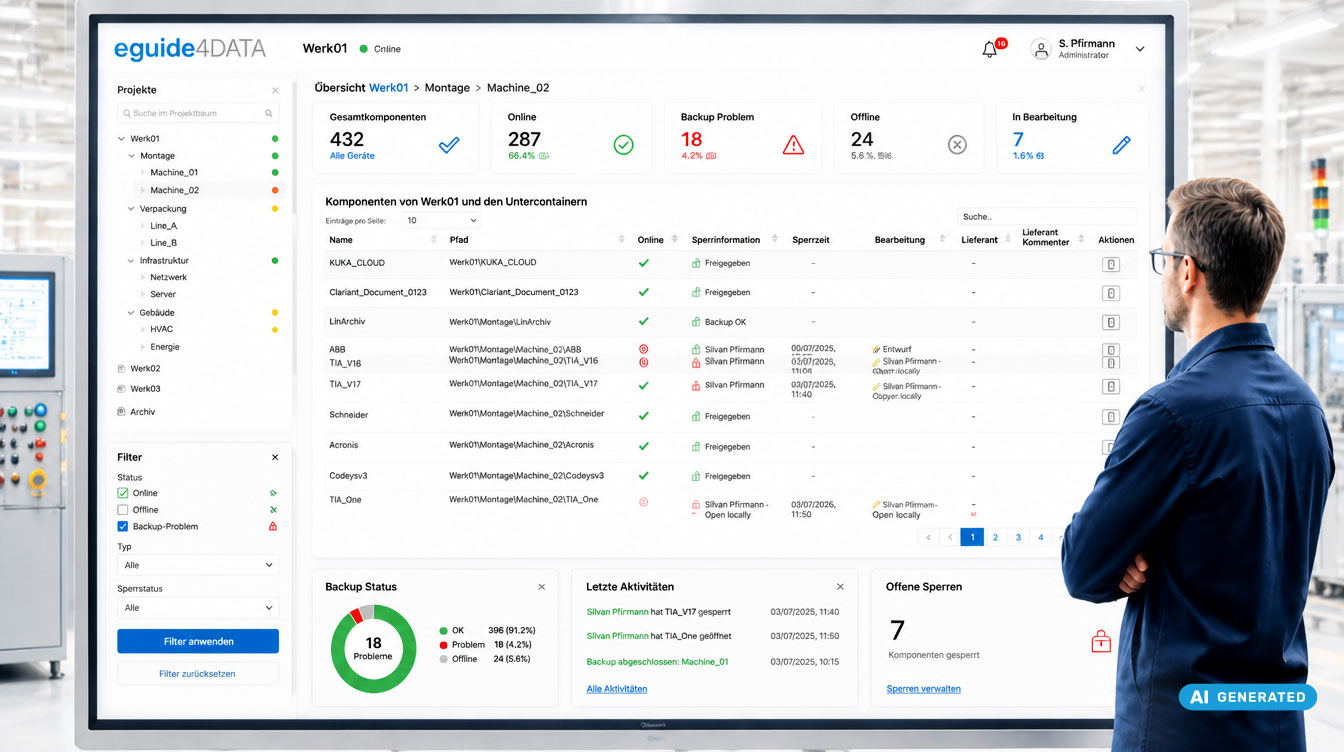
With eguide4DATA, this evidence can be generated automatically during ongoing operation instead of being compiled manually. Backup logs, version histories and change logs are available at any time.