




A cyberattack on IT systems is now a realistic scenario for many organizations. But what happens when it is not the office IT environment that is affected, but the control layer? What if PLCs, HMIs, or production systems suddenly fail? This is exactly why organizations need an OT Incident Response Plan.
A well-designed emergency response plan can make the difference between restarting production within a few hours and experiencing days of downtime.
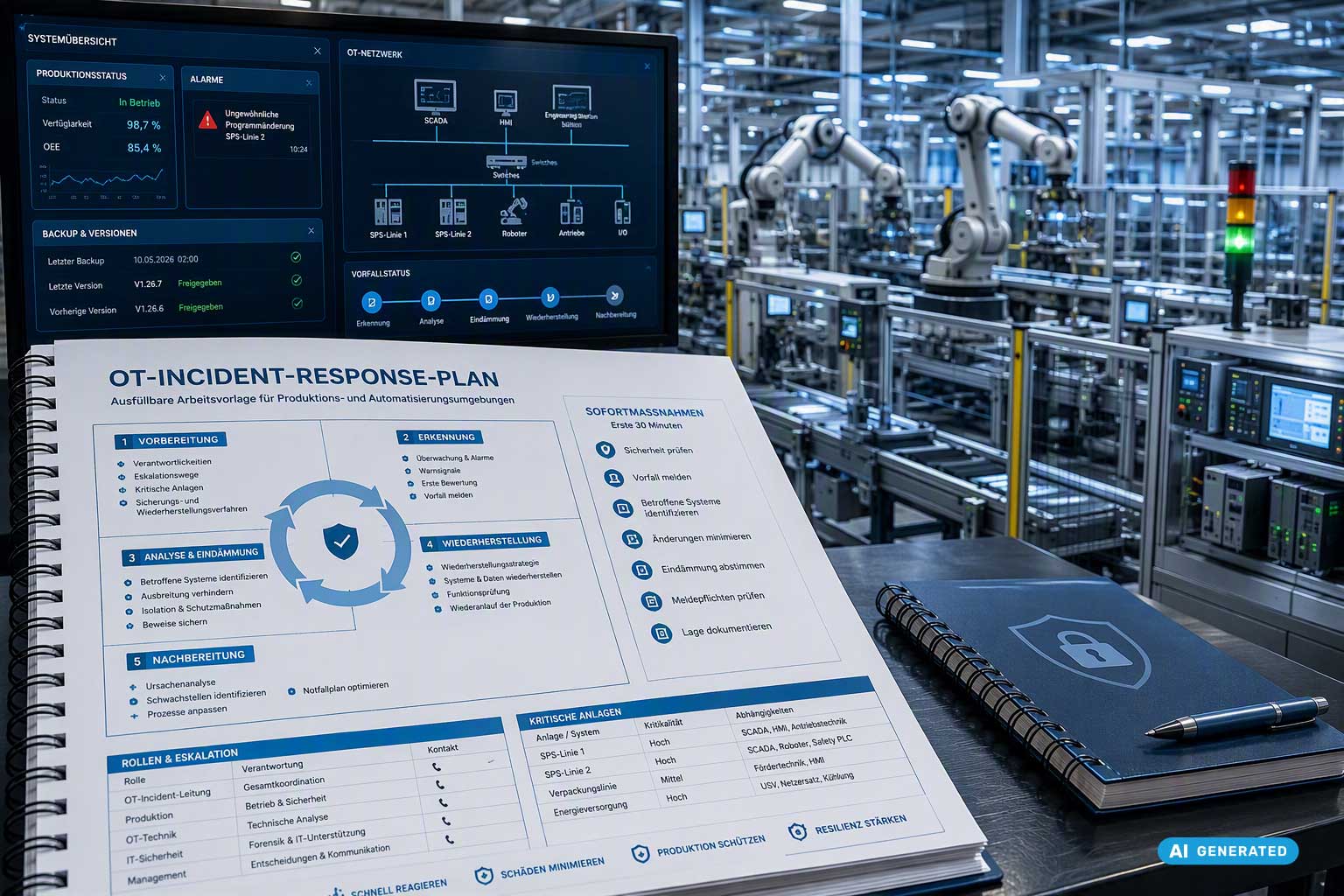
Free OT Incident Response Plan Template for Download
Many organizations recognize the need for an emergency response plan but lack a structured template that can be applied in practice.
That is why we provide a free OT Incident Response Plan template. The template helps you systematically document responsibilities, escalation paths, critical assets, reporting procedures, and recovery measures.
The template includes:
- ✅ Immediate response actions for the first 30 minutes
- ✅ Roles and escalation matrix
- ✅ Inventory of critical assets and systems
- ✅ Analysis and containment logs
- ✅ Recovery and restart planning
- ✅ Reporting and communication plan
- ✅ Incident and action log
- ✅ Lessons learned section for post-incident review
Why an OT Incident Response Plan Is Essential Today
With the implementation of NIS2, incident management is becoming an increasingly important focus for many industrial organizations. An effective process for handling security incidents is one of the measures that affected organizations must be able to demonstrate.
One critical aspect is often overlooked:
An attack on OT systems can bring production processes to an immediate halt and cause significant financial damage.
While established incident response and emergency plans often exist for IT environments, comparable processes for industrial control and automation systems are still frequently missing altogether.
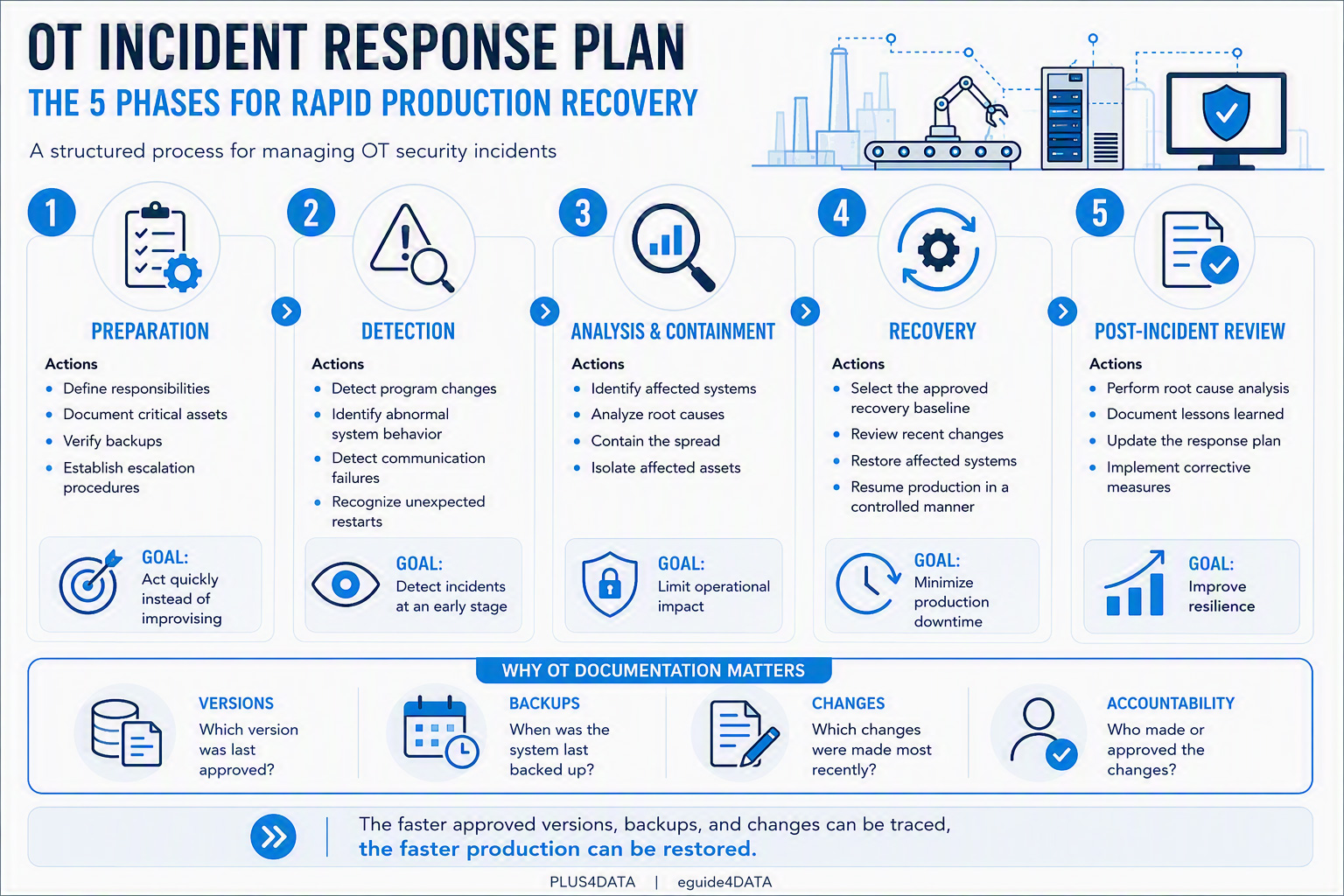
The 5 Phases of an Effective OT Incident Response Plan
1. Preparation
The most effective response to a security incident begins long before the actual event occurs. The following elements should be documented:
- ✅ Roles, responsibilities, and escalation paths
- ✅ Critical assets and systems
- ✅ Internal and external contacts
- ✅ Backup and recovery procedures
2. Detection
The earlier an incident is detected, the lower the potential impact. Typical warning signs include:
- Unexpected program modifications
- Abnormal system or equipment behavior
- Unplanned restarts
- Communication failures between systems
3. Analysis and Containment
The objective of this phase is to understand the incident and prevent it from spreading. Key questions include:
- Which systems are affected?
- What changes have been made?
- Which assets need to be isolated?
4. Recovery
At this stage, every minute counts. Affected systems must be restored using trusted and approved data versions. The faster the last known good state can be identified, the sooner production can resume.
5. Post-Incident Review
Once the incident has been resolved, the critical learning phase begins:
- Conduct a root cause analysis
- Identify weaknesses and vulnerabilities
- Adjust and improve processes
- Optimize the incident response plan
In this way, every incident becomes an opportunity to strengthen resilience.
Don’t Forget Reporting Obligations
For many organizations, NIS2 introduces specific requirements for reporting significant security incidents. Therefore, an OT Incident Response Plan should not only include technical procedures but also clearly define:
- Who is responsible for reporting?
- To whom must the incident be reported?
- What information must be provided?
If these questions still need to be answered during an incident, valuable time is lost.
Why OT Documentation Is Critical
An OT Incident Response Plan only works reliably if the necessary information is readily available. During a critical incident, questions such as the following must be answered quickly:
- Which version was the last approved version?
- When was the system last backed up?
- What changes were made most recently?
- Who made those changes?
If this information is missing, the analysis and recovery phases can be significantly prolonged.
Common Weaknesses in Existing Emergency Response Plans
When reviewing their preparedness, many organizations identify similar weaknesses:
- ❌ The emergency response plan only covers IT systems
- ❌ OT systems are not integrated
- ❌ Roles and responsibilities are not documented
- ❌ Current backups are missing
- ❌ Emergency response exercises have never been conducted
- ❌ The last approved system state cannot be clearly traced
Practical Example: When Every Minute Counts
Situation
A security incident affects a production asset. Recovery must be carried out as quickly as possible.
Without Structured Documentation
- Multiple backups need to be reviewed
- Responsible teams search for the last known operational state
- Analysis is significantly delayed
With Documented Version States
- Approved versions can be identified more quickly
- Changes can be traced and verified
- Recovery can be planned and executed in a structured manner
Conclusion: The faster relevant information is available, the sooner recovery can begin.
First Steps Toward Your Own OT Incident Response Plan
- Assign responsible personnel for OT incidents
- Prioritize critical assets
- Review your backup and recovery strategy
- Define reporting and escalation procedures
- Conduct emergency response exercises
- Regularly update documentation
Conclusion
An OT Incident Response Plan is not merely a theoretical compliance measure. It is a critical component of resilience for modern manufacturing organizations. Companies that define responsibilities, recovery procedures, and the required information in a structured manner before an incident occurs can respond much faster and with greater control when a real incident happens.
Get Started Today: Download the Free Template
Organizations that want to respond quickly during a critical incident should not wait until an actual event occurs to begin creating an emergency response plan.
Our free OT Incident Response Plan template provides a structured framework for documenting responsibilities, recovery procedures, and communication pathways.
Use the template as a starting point for your own OT emergency response plan and adapt it to your specific asset landscape and internal processes.
Important Notice:
The provided template is intended solely as a non-binding guide and must be individually adapted to the respective organizational, production, and asset environment.
FAQ - OT Incident Response Plan
Is an IT Emergency Response Plan Sufficient for OT?
Generally, no. OT systems have different requirements, responsibilities, operational constraints, and recovery procedures than traditional IT systems.
How Often Should an Incident Response Plan Be Tested?
At least once a year, and additionally whenever significant changes are made to the production environment, automation systems, or OT infrastructure.
Who Should Be Involved in an OT Emergency Response Plan?
Typically, key stakeholders include Production, Maintenance, OT/Automation personnel, IT Security, and Management.
Is the Template Legally Binding or NIS2-Compliant?
No. The template is intended as a practical working aid for developing an OT Incident Response Plan. It does not constitute legal advice and cannot replace the individual assessment of regulatory, organizational, or industry-specific requirements. Organizations should adapt the content to their specific processes, systems, and compliance obligations.